ServicesRoof Inspections
Roof Inspections in Neptune Beach
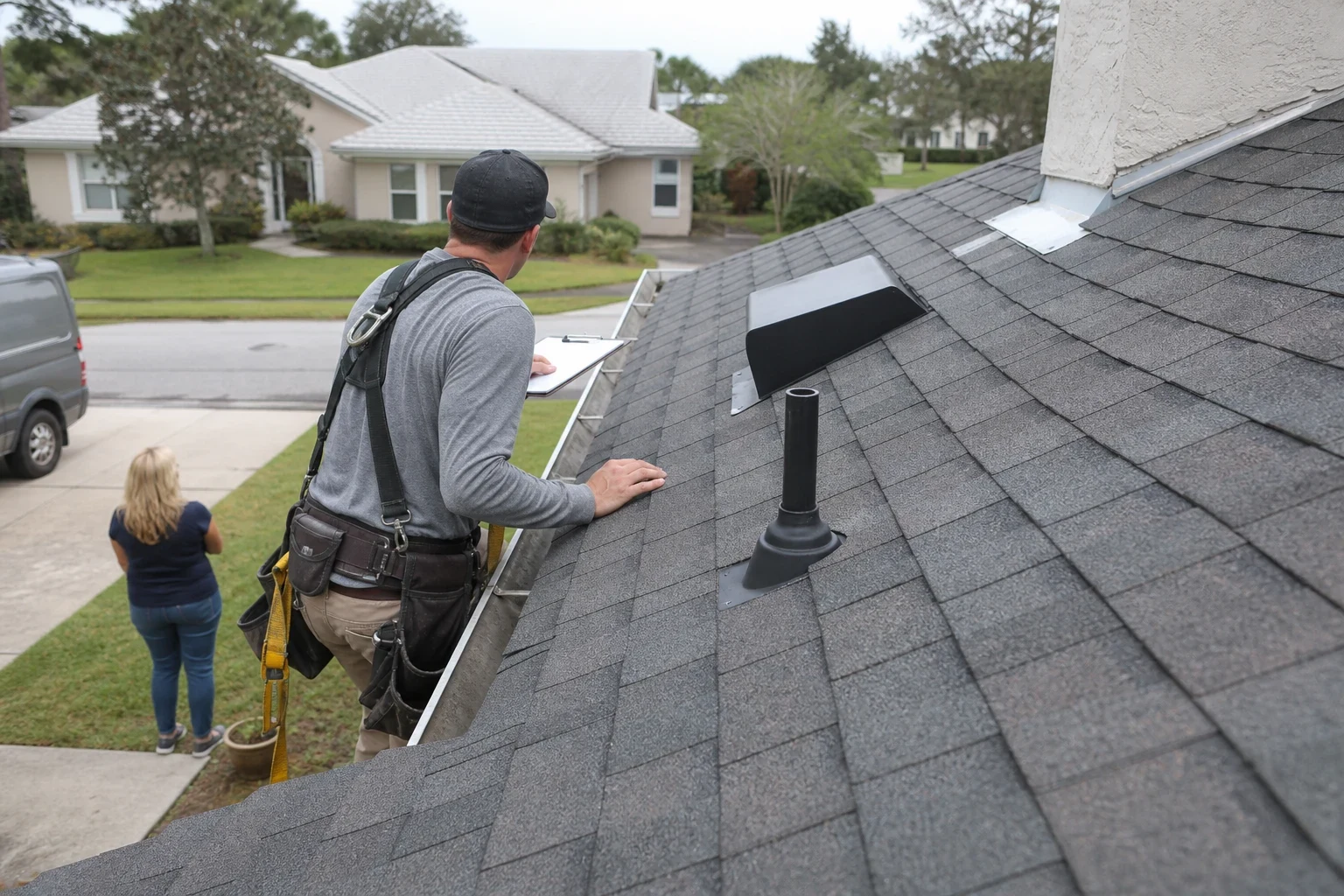
We check your roof the way it was built: the surface material, the flashing, the fasteners, the decking and the attic underneath. You get photos of what we found and a straight explanation of whether it needs repair, replacement or nothing at all.
What a Roof Inspection Actually Tells You
Roofs seldom give out in a single day. Water usually gets in at one small weak point, such as a split rubber collar around a vent pipe, a shingle whose tab has come unsealed or a screw that has rusted through its washer. It can soak the decking for months before your ceiling shows anything. Catching that early, while the fix is still small, is the reason to inspect.
Each roofing material wears out in its own way, so we inspect each one on its own terms. Asphalt shingles lose granules and their sealant strips let go in high wind. Concrete tile holds up well, but the underlayment beneath it ages faster than the tile does. Metal panels resist wind, yet their fasteners and washers corrode in salt air. Knowing which failure to look for is most of the job.
An inspection makes sense before you buy or sell a home, after a strong storm, when a roof passes about 15 years, or when you simply want to know where you stand before hurricane season.
What We Check on Every Inspection
Roof surface
We look for missing, cracked or curled shingles, granule loss, slipped or broken tiles, and loose or dented metal panels. We also note algae streaking, which is cosmetic on its own but tells us how water sits on the roof.
Flashing and penetrations
Step flashing at walls, counter flashing at chimneys, and the boots around plumbing vents are where most leaks start. Neoprene pipe boots crack under strong sun, and we check every one.
Fasteners and edges
We check for nail pops, backed-out screws on metal roofs, and corrosion on drip edge and fasteners. Near the ocean, steel that was not rated for coastal exposure shows rust early.
Sheathing and attic space
Under the roof covering, we examine the underside of the plywood for water marks, pinholes of light, soft spots and wet insulation. We also confirm the soffit intake and ridge or gable exhaust are moving air, because heat and humidity trapped up there shorten the life of shingles and underlayment.
Gutters and drainage
A gutter packed with leaves or pulling away from its hangers lets runoff back up over the drip edge, where it soaks the fascia board and the lowest strip of decking. When drainage is behind a problem, we tell you and point you to our gutters service.
When an Inspection Is Worth Scheduling
A new spot on your drywall
Water travels along rafters and the underside of the sheathing before it drips, so the mark you see indoors is often several feet from the actual opening. The inspection follows that path back to its source.
Granules in the gutters
Shingle granules shield the asphalt from UV. When they wash out in quantity, the shingles are nearing the end of their service life.
After a named storm or high wind
Wind can break the sealant bond on shingles without tearing them off, which leaves them loose for the next storm. Our free post-storm inspections catch this before it turns into a leak.
A roof with an unknown history
If you just bought your home, or the roof is past 15 years and you don't know what was done to it, a baseline inspection tells you what material is up there and how much life it has left.
Rust streaks or loose panels
On a metal roof, rust near screw heads usually means the washers have failed and water is reaching the fastener hole.
How Your Inspection Goes
- 1
Book by phone
On the phone, tell us what your roof is made of, roughly how old it is and anything you've noticed. We pick a time that suits you and send a technician, and the visit costs you nothing.
- 2
Exterior and roof walk
We begin from the ground, reading the gutters, fascia and roof lines, then climb if the pitch and material make it safe. Concrete tile gets extra care: we keep our footing over the overlapped part of each tile, where the course beneath backs it up.
- 3
Attic check
With your permission we look in the attic for staining, ventilation problems and decking damage that can't be seen from above.
- 4
Findings with photos
We go over what we found with you, using photos of each issue. For each one we explain the cause, how urgent it is, and whether it calls for roof repair, a full roof replacement, or just monitoring.
What Moves the Price of Follow-Up Work
You pay nothing for the inspection and owe us nothing afterward. When repairs or a new roof are called for, your free estimate breaks out each item on its own line, so the total makes sense before you decide. Financing is available for bigger projects.
- Roofing material
- Shingle repairs are usually the simplest. Concrete tile takes more labor because tiles must be lifted and reset, and metal repairs depend on matching the panel profile and finish.
- Decking condition
- Soft or rotted plywood under the roof covering has to be replaced before anything goes back on top. We can't always see the full extent until the surface comes off, and we tell you that up front.
- Roof height and slope
- A second-story eave or a sharp pitch means harnesses, roof anchors and slower, more deliberate movement for the crew. That extra time shows up on the labor line.
- Flashing complexity
- Chimneys, skylights, dormers and roof-to-wall joints all need custom-bent flashing, which adds labor compared with an open, simple roof plane.
Roof Inspection Questions
Something not covered here? (904) 406-7271
Is the inspection really free?
Yes. The technician visit costs nothing, and you are under no obligation to hire us for any work we find. If the roof is in good shape, we tell you that and leave it there.
How often should my roof be inspected?
Once every year or two is reasonable for most roofs, and after any storm with high wind. Shingle roofs past 15 years and tile roofs with original underlayment benefit from closer attention, because that is when failures tend to start.
Will walking on my tile roof break tiles?
Concrete tile can crack if you step on an unsupported spot. We walk tile roofs only on the supported lower edge of each tile, and if a roof isn't safe to walk, we inspect from a ladder and the attic instead.
Will the inspection help if I file a storm damage claim?
It can. After a storm the visit is free, and we photograph every damaged spot so you have a dated record before deciding whether to file. If you do file, we work directly with your insurance adjuster on storm damage claims. The repairs themselves fall under our storm damage repair service.
Is this the same as the form my insurer asked for?
Not necessarily. Some Florida insurers request specific signed forms for policies, and those have their own requirements. Our inspection is a roofer's assessment of condition and needed work, so check with your insurer about what they need.
How long does an inspection take?
Most single-family roofs take about an hour or two, depending on size, pitch and how many penetrations and transitions the roof has. Attic access adds a little time but often tells us the most.
Find Out What Your Roof Needs
A technician will check your roof's surface, flashing and attic and show you every finding in photos. We serve Neptune Beach, Atlantic Beach, Jacksonville Beach and nearby communities.